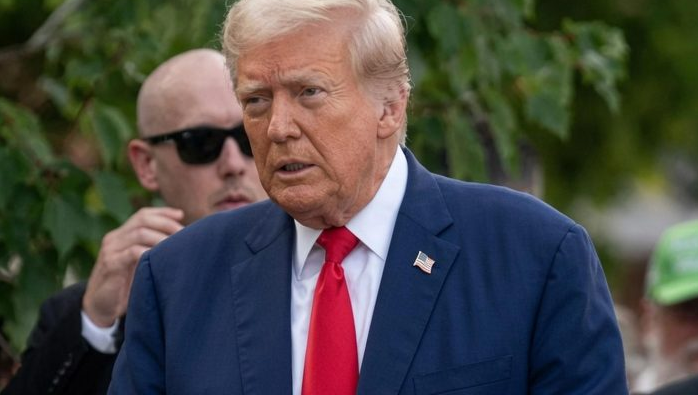
President Donald Trump is implementing measures to restrict non-citizens’ access to financial systems in the United States as part of his administration’s broader immigration enforcement.
Advertisement In accordance with the 1970 Bank Secrecy Act, the new order mandates that the Treasury Secretary and federal financial regulators provide banks with guidance on identifying customers whose profiles or transactions may indicate risks such as money laundering, terrorism financing, and labor trafficking.
The order stated that the purpose of these modifications is to “take into account the potential threats to the integrity of the United States financial system posed by foreign consular identification cards. ”
Advertisement The order describes “red flags and typologies” associated with suspicious activity
The order describes “red flags and typologies” associated with suspicious activity.
Among these are repetitive cash withdrawals, the use of shell companies to conceal true account ownership, and the use of certain platforms for “off-the-books” wage payments.
Advertisement The “red flags” also encompass the use of an individual taxpayer identification number (ITIN) in place of a Social Security number when opening an account or performing specific banking transactions. This number is accessible to all, irrespective of their immigration status, and is used to file and pay taxes.
Even for legitimate reasons, the move could exacerbate the challenges faced by non citizens, particularly undocumented immigrants, in obtaining financial services
The U. S. government has implemented a stringent policy regarding immigration, regardless of whether it is legal or illegal, has restricted the access of immigrants to public services, increased scrutiny for visa and citizenship applications, and detained and deported individuals in mass, including those with lawful immigration status.
Protests across the nation have been incited by extensive immigration operations, which have resulted in the deaths of numerous Americans at the hands of federal agents.
In November, the Treasury Department also disclosed its intention to reclassify specific refundable tax credits as “federal public benefits,” which would limit the eligibility of certain non citizens who submit taxes in the United States
“President Trump is taking action to restore integrity to America’s financial system, cracking down on illicit activity that threatens national security and ending the extension of credit to high-risk borrowers that American citizens are forced to subsidize,” a White House fact sheet for the order said.
“Restoring sound underwriting standards puts money back in the pockets of law-abiding Americans,” the order added.
The fact sheet claimed that “gaps in customer identification practices have allowed terrorists, drug traffickers, money launderers, and other criminal networks to exploit U.S
The White House also pointed to cases of banks extending mortgages, credit cards, and loans to undocumented immigrants and employers underreporting wages for undocumented employees, arguing that associated “costs are passed on to American consumers in the form of higher fees and interest rates. ”
Economists generally attribute higher rates to benchmark rates, which are used to balance inflation and job growth, bank funding costs, and individual factors like borrowers’ credit scores.
According to a study by the left leaning Urban Institute, lenders issued around 5,000 to 6,000 mortgages to customers with ITINs
Banks are generally reluctant to lend to customers with ITINs, and Fannie Mae and Freddie Mac are typically disinclined to insure mortgages for borrowers with an ITIN.
The order also directs the Treasury to consider regulatory changes under the Bank Secrecy Act that would enable financial institutions to more readily collect customer data, including immigration status and employment authorization.
6, 2021, Capitol riot
JPMorgan Chase said in January, “Our company does not close accounts for political or religious reasons. We do close accounts because they create legal or regulatory risk for the company. We regret having to do so, but often rules and regulatory expectations lead us to do so.”
At the same time, the White House has overseen a broader deregulatory push that has benefited firms outside the traditional banking framework, and openly embraced cryptocurrency, with Trump pledging to make the U. S.
the “crypto capital of the planet. ”