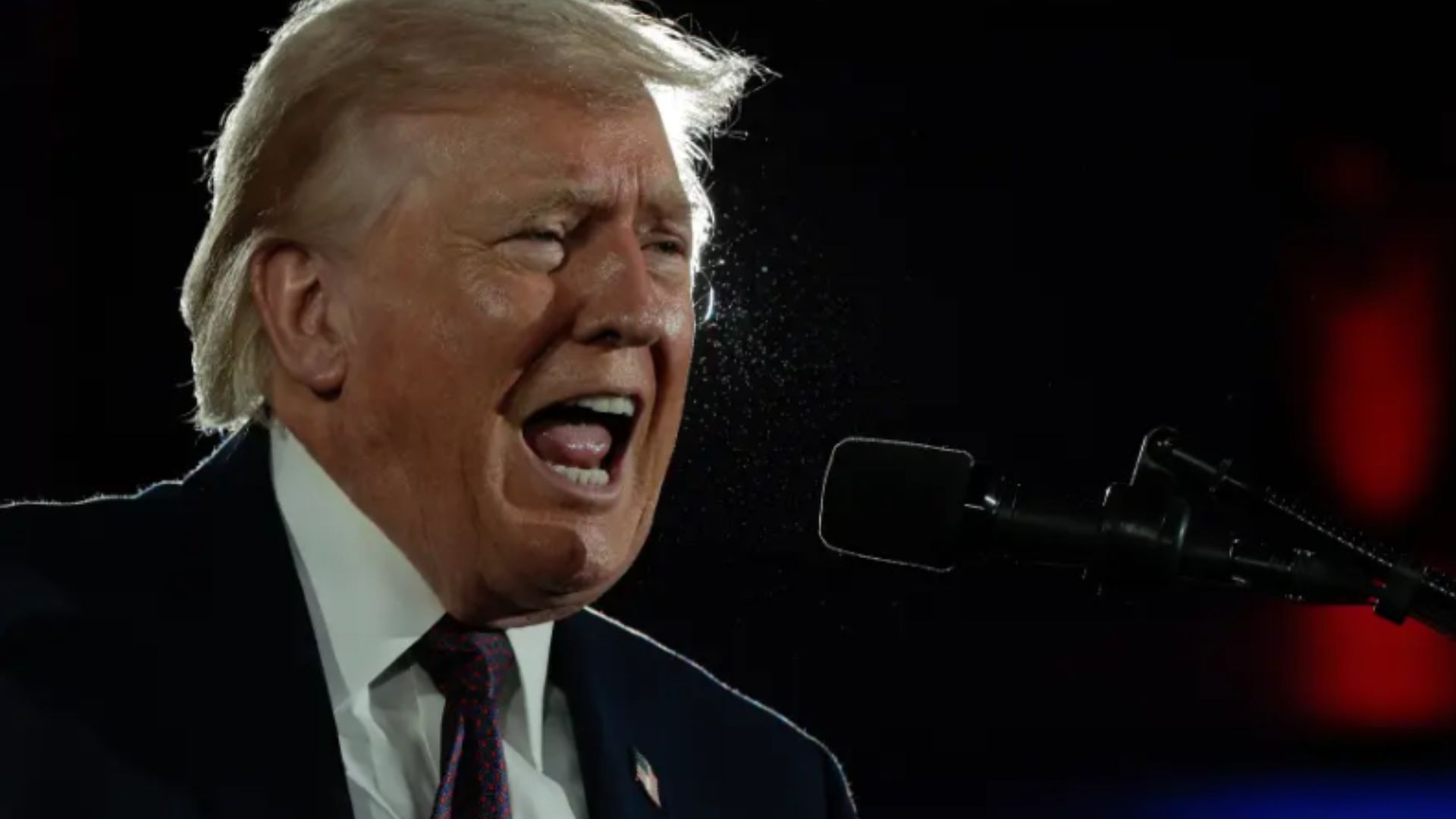
President Trump issued an early morning warning to Iran Thursday, telling Islamic Republic officials to buckle down and “get serious” about negotiating an end to the four-week-old war “before it is too late” as the US military prepares an assault it hopes will be the “final blow” to the Tehran authorities.
“The Iranian negotiators are very different and ‘strange,’” the president posted on Truth Social. “They are ‘begging’ us to make a deal, which they should be doing since they have been militarily obliterated, with zero chance of a comeback, and yet they publicly state that they are only ‘looking at our proposal.’ WRONG!!!
“They better get serious soon, before it is too late,” Trump added, “because once that happens, there is NO TURNING BACK, and it won’t be pretty!”


The president’s rant came as Axios reported that military officials were prepping a massive bombing campaign if talks go nowhere and were readying four primary options that Trump could choose from to impose maximum pressure on the theocratic regime.
Those options reportedly include invading or blockading Iran’s oil export hub of Kharg Island; seizing Larak Island, which Tehran uses as a military outpost to maintain control of the strategic Strait of Hormuz, through which an estimated one-fifth of the world’s oil passes; seizing three other islands near the western entrance to the strait that are controlled by Iran but claimed by the United Arab Emirates; and stopping or seizing ships sending Iranian oil through the strait, choking off the mullah’s major economic lifeline.
Alex Plitsas, a former Pentagon official and current fellow at the Atlantic Council, told The Post that taking over the islands would prevent Iran from using them “to strike at ships that are in the area.
“Kharg, in particular, is where 90% of the oil is loaded for Iran, so that is more of the US taking a chess piece off [Iran’s] board and putting another bargaining chip in its pocket to deal with the Iranians,” he added. “I think the thought there is that if they take Kharg and the Iranians were to attack and blow up their own infrastructure, that would be basically self-defeating. So in this case, it would be an operation to seize the island and force the Iranians to negotiate.”
While the Iranians may not attack US forces on Kharg Island, Plitsas went on, “they may attack regional energy, oil and gas infrastructure in other countries.”
The difficulty is that if Trump decides to send in ground forces, they would likely have to attack the islands by air rather than sea.
“You’d have to transit The Straits with the ships in order to get in there to [put Marines on islands using landing crafts], and we can’t do that,” he explained. “You’d give up the element of surprise, and the straits are contested right now.”
“If they come out by air, you’d be vulnerable to shoulder-fired missiles up to 12,000 feet and below. And then Iran has land attack cruise missiles, as well. So the US would have to account for all of that as part of the planning process.”
The president could also order special forces to secure highly enriched uranium buried at three nuclear facilities hit by the US this past June, or call for a second round of airstrikes to ensure the material remains inaccessible, Axios reported.

Meanwhile, Pakistani Foreign Minister Ishaq Dar confirmed for the first time Thursday that indirect talks between the US and Iran were taking place, mediated by the Islamabad government as well as Egypt, Turkey and other countries.
Reports circulated earlier this week that Vice President JD Vance could travel to Pakistan this coming weekend to seal a cease-fire deal, but a source told The Post Wednesday that while such an intervention was a “possibility,” it was not “even close to happening.”
Trump initially raised hopes for an end to the war that has decimated Iran’s top leadership and rattled the global economy on Monday, when he announced he was postponing planned strikes on the Islamic Republic’s energy infrastructure by five days to allow time to work out an agreement to end the fighting.
While the US and Israel kept up the pace of air attacks targeting Iran’s military apparatus and regime figures, Washington submitted a 15-point peace outline to their Tehran counterparts.
The American demands included Iran dismantling nuclear facilities and capabilities as well as forgoing the pursuit of atomic weapons; handing over all enriched uranium to international authorities; limiting its missile program to self-defense uses; keeping the Strait of Hormuz open to energy shipping; and cutting off funding for terrorist proxies.

Despite Trump claiming Tuesday that Iran had agreed to forgo the pursuit of a nuclear weapon, the Iranians responded that the US demands were unacceptable and presented their own outline that would give them control of the strait and keep funding its terror proxies — including Hamas and Hezbollah.
While the talks have been taking place, more American ships and thousands of ground forces have been en route to the Middle East.
The military campaign against Iran reaches the end of its fourth week Friday, and Trump suggested on the war’s second day it would last “four weeks or so.”
“What we had to do is get rid of the cancer,” Trump told Republican lawmakers Wednesday night. “We had to cut out the cancer. The cancer was Iran with a nuclear weapon. We’ve cut it out. Now we’re going to finish it off.”
“They are negotiating, by the way,” the president added, “and they want to make a deal so badly, but they’re afraid to say it because they figure they’ll be killed by their own people. They’re also afraid they’ll be killed by us.”