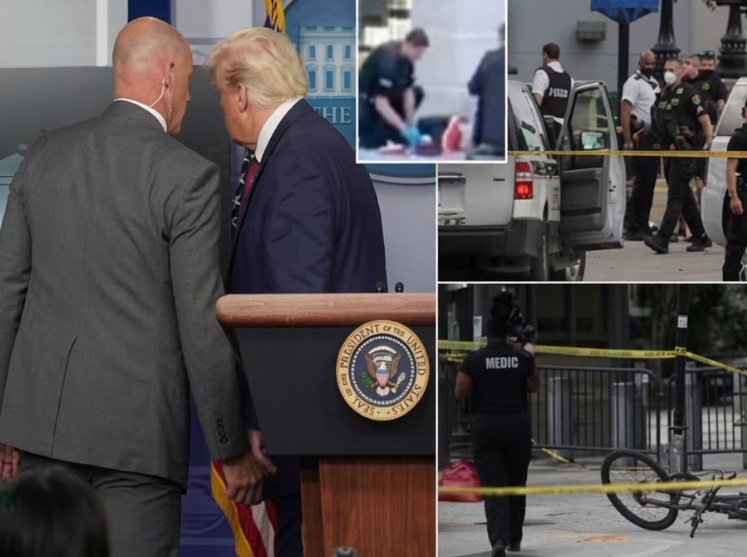
President Donald Trump was at the White House at the time. Officials said operations continued as normal, though security in the area was increased, the Associated Press reported. The park has been closed off in recent weeks due to renovation work.
The Secret Service said it is coordinating with the Metropolitan Police Department of the District of Columbia and the U.S. Park Police as the investigation continues, the AP added.
Meanwhile, the U.S. and Iran agreed to a two-week cease-fire Tuesday evening as Trump’s 8 p.m. EDT deadline approached to ramp up attacks on the Islamic Republic’s power infrastructure.
Vice President JD Vance, speaking to an audience in Hungary alongside Prime Minister Viktor Orban early Tuesday, addressed the looming deadline.
“We feel confident that we can get a response, whether it’s positive or negative, we’re gonna get a response from the Iranians by 8 o’clock tonight,” Vance began. “I hope they make the right response because what we really want is we want a world where oil and gas is flowing freely, where people can afford to heat their homes and cool their homes, where people can afford to transport themselves to work.
“That’s not gonna happen if the Iranians are engaged in acts of economic terrorism,” the vice president continued. “They’ve got to know, we’ve got tools in our toolkit that we so far haven’t decided to use. The president of the United States can decide to use them, and he will decide to use them if the Iranians don’t change their course of conduct.”
A week ago, Trump said Iran had agreed to allow additional oil tankers to pass through the Strait of Hormuz, describing the move as a “tribute” to the United States as negotiations continue over a potential end to the escalating conflict.
Speaking to reporters aboard Air Force One, Trump said Iran had expanded an earlier concession involving 10 tankers to include 20 more vessels, signaling what he characterized as a step toward de-escalation.
“They gave us… 20 boats of oil. Big, big boats going through the Hormuz Strait,” Trump said. “That’s taking place starting tomorrow morning.”
The announcement builds on what Trump previously described as an initial “gift” earlier in the week, tied to ongoing discussions between U.S. officials and Iranian representatives. The Strait of Hormuz remains central to the negotiations, given its strategic role as a global energy chokepoint.
Before the conflict began in late February, the narrow waterway handled roughly one-third of global oil exports. Since then, traffic has reportedly dropped by as much as 90 percent, contributing to volatility in global energy markets and raising concerns among U.S. allies and international partners.
Administration officials have framed Iran’s decision to allow limited tanker passage as a positive signal, though questions remain about the scope and durability of the arrangement. Iranian officials have downplayed the move, suggesting the shipments reflect routine regional trade rather than a concession tied directly to U.S. demands.
Trump on Saturday warned Iran of dire consequences if the Middle Eastern country does not reopen the Strait of Hormuz or agree to a ceasefire deal within 48 hours. “Remember when I gave Iran ten days to MAKE A DEAL or OPEN UP THE HORMUZ STRAIT,” he wrote on Truth Social. “Time is running out — 48 hours before all Hell will reign down on them. Glory be to GOD!”
He appeared to drop a similar warning late Sunday, according to a Truth Social post that said, simply, “Tuesday, 8 P.M. Eastern Time!”
The Strait of Hormuz, a crucial shipping route for oil, was closed by Iran in retaliation for the recent U.S.-Israeli attacks. The closure has unsettled the global energy market.