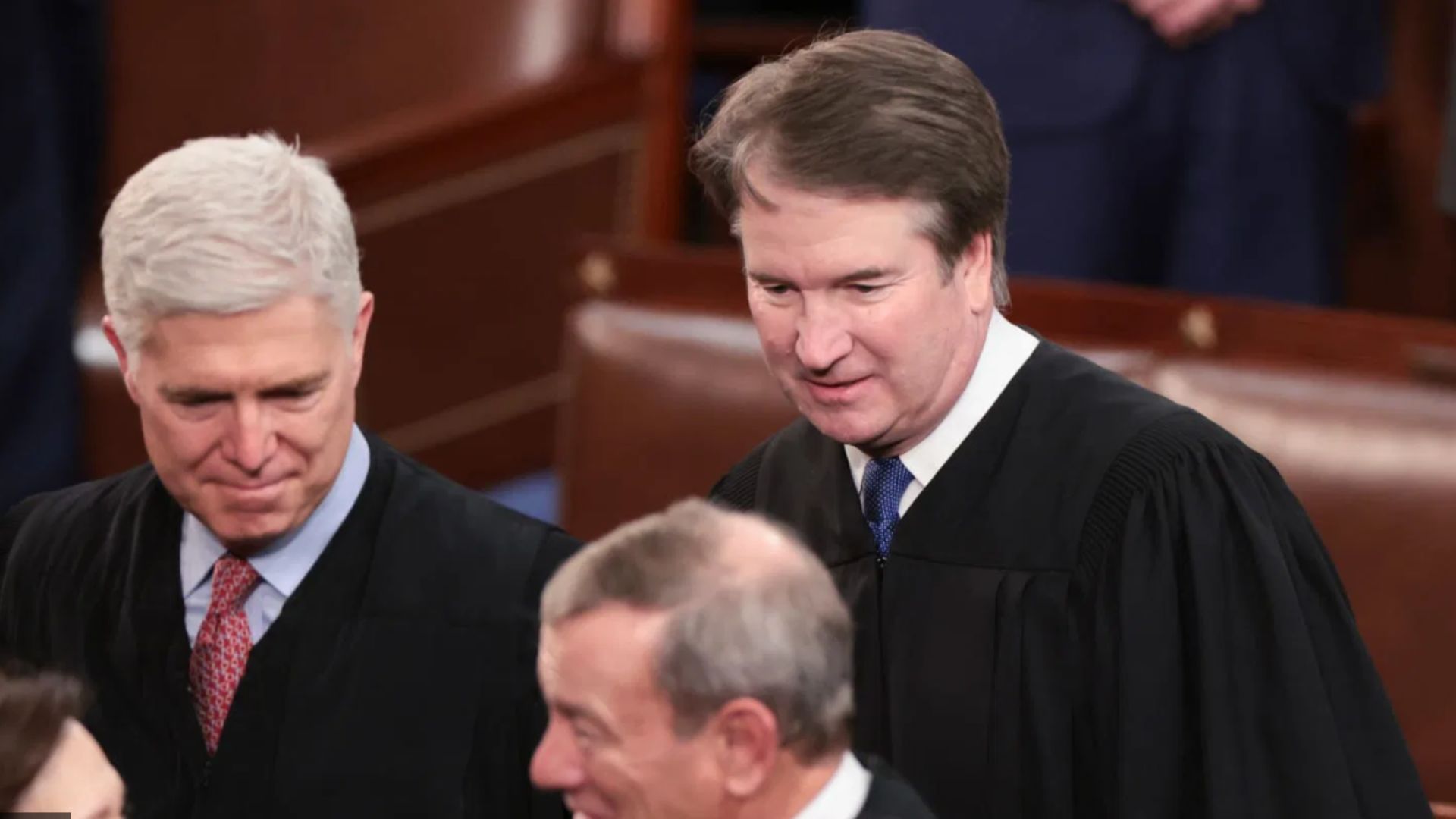
Supreme Court Justices Neil Gorsuch and Brett Kavanaugh issued warnings this summer to lower court judges, cautioning them against defying precedents set by the high court in a series of cases involving President Donald Trump’s administration.
“Lower court judges may sometimes disagree with this court’s decisions, but they are never free to defy them,” Gorsuch wrote in an opinion last week.
The decision was related to Trump’s cancellation of nearly $800 million in federal research grants. Kavanaugh joined the opinion, which criticized a district court for disregarding an earlier Supreme Court order.
Gorsuch noted that it was “the third time in a matter of weeks this court has had to intercede in a case ‘squarely controlled’ by one of its precedents.” He added, “When this court issues a decision, it constitutes a precedent that commands respect in lower courts.”
The decision allowed the administration to keep the grants frozen, overturning a ruling from U.S. District Judge William Young, who made the baseless claim he had “never seen government racial discrimination like this.”
Other justices have also criticized lower courts. In March, Justice Samuel Alito said a federal judge had committed an “act of judicial hubris” in a case involving another Trump policy.
The high court has sided with the administration on a number of emergency docket cases this year, including disputes over immigration, spending, and the leadership of independent agencies. In some instances, the justices have ruled in Trump’s favor even when the executive branch had not complied with lower court orders.
Justice Ketanji Brown Jackson, dissenting in the NIH funding case, compared the majority’s approach to “Calvinball jurisprudence,” referring to the comic strip in which rules constantly change. “Calvinball has only one rule: There are no fixed rules,” she wrote. “We seem to have two: that one, and this administration always wins.”
Justice Sonia Sotomayor has also criticized the majority’s handling of Trump cases. In a dissent earlier this summer involving deportations, she wrote that the court was “rewarding lawlessness.” “This is not the first time the court closes its eyes to noncompliance, nor, I fear, will it be the last,” she said.
Conservative legal figures defended Gorsuch’s warning. James Burnham, a former clerk for Gorsuch who served in the Trump administration, said, “The defiance of the Supreme Court’s emergency orders by some lower courts is unprecedented, extraordinary, and the Supreme Court must deal with it decisively.” Carrie Severino of the Judicial Crisis Network wrote that it had “become necessary to remind district judges not to flout orders of the Supreme Court.”
At issue is how much weight lower courts should give to the Supreme Court’s emergency orders, which are often unsigned and issued without detailed reasoning. While the justices have emphasized that such rulings are not conclusive on the merits, recent opinions have said they should still guide short-term outcomes in similar cases.
In July, the court ruled in favor of Trump’s decision to remove three members of the Consumer Product Safety Commission appointed by President Biden. The unsigned opinion pointed to an earlier emergency order concerning removals at labor agencies and said the CPSC case was “squarely controlled” by that precedent.
The court also issued a major ruling this year restricting the power of district judges to impose nationwide injunctions, which had been used in both Republican and Democratic administrations to block policies. The decision came in a case involving Trump’s order to end birthright citizenship.
Speaking in California this summer, Justice Elena Kagan said the court could “explain things better” to help lower courts apply its orders. Days later, in remarks to judges and lawyers in Kansas City, Kavanaugh said judges must focus on their constitutional role.
“Members of the judiciary have an important responsibility, of course, that goes with maintaining the independence — that responsibility, of course, to get it right, to do our hard work, to understand our role in the constitutional democracy,” Kavanaugh said. “We’re not the policymakers.”